Monday, 8 July 2013

Babies and the Bookness of Books


This week we have a guest blogger, Jane Blatt, who is the author of a picturebook which is all about books. Her reflections show how relevant the topic and representation of books is even for the youngest of audiences.


Babies and the Bookness of Books

By Jane Blatt, author of Books Always Everywhere (illustrated by Sarah Massini. Nosy Crow 2013)

We know how important it is for babies, even very small ones, to be read to by parents or carers, snuggled safely in their arms but I am passionate about babies also having the opportunity to explore books on their own. Children will learn through their own explorations that books have pages which can be turned backwards and forwards, that they have images which are interesting and colourful and eventually, if books are held in a certain way, that images can look the ‘right’ way up and may even follow in a meaningful sequence. Playing with such fascinating physical objects as books allows children not only to become familiar with the ‘bookness’ of books (my term) but also to learn more about the world about them through their bodies and senses. This playfulness and exploration is part of the natural process involved in fundamental general learning which all normally developing children gain in the first 3 years of their lives and which is the basis for all later skills. (Every Child Can Learn by Katrin Stroh, et al, Sage 2008)

Books Always Everywhere came about when Evelyn and I were reviewing data for a chapter on how picture books can support the emotional learning of bilingual children (Arizpe, E. and Blatt, J. 2011 ‘How Responses to Picturebooks Reflect and Support the Emotional Development of Young Bilingual Children’, in B. Kümmerling-Meibauer (ed) Emergent Literacy. Children’s Books from 0 to 3. Amsterdam: John Benjamins). We were watching a video of an 8 month baby exploring books on her own. She was sitting on the floor surrounded by all kinds and sizes of children’s books and for some moments explored one in particular. She picked it up, dropped it, mouthed it, moved it with her foot, opened it, felt it, weighed it in her hands, smelt it, even looked at it from different angles, maybe even noticed that there were different shapes or images on different parts of it. Her whole body was focussed on the task she had started and continued on her own and for herself. There were the occasional concentrated grunts from her totally integrated body but no one told her what to do and certainly no one ‘helped’ her in her exploration.

Later, in another clip with this baby a few months later, we saw her making a mat on the floor with books, then making the books into houses for small figures. She piled them and built with them. She lay down with them and even put one of them on her head as if it were a hat. She was gaining more and more experience about the joys of the ‘bookness’ of books. She was also learning about ‘placing’, ‘matching’, ‘sorting’, ‘sequencing’, ‘building’, ‘banging’ and building up her early general learning.


The clips and discussion inspired me to write a picture book for babies exploring the physical nature of books. Nosy Crow, a new publishing company, were excited by the script: “One of the great things about the text is the elliptical, compressed and lyrical nature of it”.  ‘Book Big/ Book Small/ Book Wide/ Book Tall... came to life through the illustrations by Sarah Massini. The initial illustrations show only one baby and one book, but as the pages turn, more and more babies and different kinds of books appear. My original text went through some changes, not least losing the adult interaction and a sense of developmental progress but the result has been enjoyed by various reviewers including the Sunday Times: “Using rhyme and no more than 2 words per page, Books Always Everywhere, is a book lover’s dream. Books take centre stage in a range of babies’ and toddlers’ real and imaginative lives” (Culture Section, 23.06.13)

A variety of formats and sizes of books are represented in Books Always Everywhere –board books, buggy books, books with holes-   and the illustrator has added images and words in some of them. The words and titles are of course meant for the literate reader; some are real titles of fairytales and nursery rhymes, others are made up as a joke that can be shared with babies too, such as the book called ‘House Mouse’ upon which a small mouse is sheltered by a book opened in the shape of a tent – much like the books in the photograph. There is certainly lots to look at in the illustrations and one can easily imagine much ‘spotting’ going on when the book is shared with an adult. The words and the pictures also suggest relationships: ‘Book Give/Book Share’, and a way of engaging with others and participating in a community.

The book has been very successful. Is part of its success due to it being a book about books in this technological world when books are being replaced by the ibook? Are parents concerned that even babies are exploring digital gadgets too early, or that they may not encounter books in the same way as previous generations? Going back to my initial idea, unlike ipads or kindles, books can be played with as toys, put on one’s head, sat on, given as presents, used to build a house, dropped, hung from a tree, even. Will this generation of babies miss out on learning about the ‘bookness of books’?  Are our children losing out on the playfulness of play? Does this matter? Will this book be seen in the future as a quaint and outdated defence of books? Or will there still be, as the title suggests and is summed up, with all the aspects of the babies’ enjoyment of books in the final illustrations, ‘Books always.... everywhere?


Jane Blatt


Tuesday, 2 July 2013

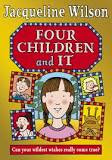
First thoughts on reading Jacqueline Wilson's 'Four Children and It'


by Vivienne Smith 

I am busy reading for next year's UKLA children’s book award at the moment – and I was pleased to see Jacqueline Wilson’s Four Children and It in the parcel from Puffin.

The book is relevant to our purposes here, because Rosalind, the narrator, and one of two main protagonists, is a reader.  We know this from the very first sentence:

“What’s that you are reading?” said Smash, grabbing the book out of my hand.

And with an economy of style that seems to me to be one of Wilson’s special talents, we are shown that Smash is disruptive and difficult. Three sentences on we know that Rosalind is not. She is reading E. Nesbit’s Five Children and It, - with enjoyment and in the original ( Thank you Peter!) and it  is not one whit too difficult for this modern child. She can concentrate.

The book, as you probably know, was written as a tribute to Nesbit’s, which Wilson loved as a child. It borrows Nesbit’s plot wholesale. The children ( this time three and a baby, rather than four) dig up the Psammead, and he grants them wishes which invariably go wrong in some way.  One wish – the ability to fly occurs in both stories, though the consequences are different for the modern children. 

Despite Wilson’s deceptively easy style, hers is ( I think) the more  complex piece of writing. As well as the the story of the wishes, there is another story here of modern family life. This is a step family thrown together for the holidays. Two children share a mother, three a father, and only one child is in its permanent home. There are tensions between the children, between the children and their parents, between the children and their step-parents, and between the two adults about each others' children. Adults feel guilty, children feel rejected, and every one, (except baby Maudie who is gloriously secure) is negotiating a place in this muddle. it is a story of accommodation and compromise and there are no easy answers, even when wishes come true.

And then there is the intertextual complexity. This is a book based on a book, in which the book features as an object and as a story. Even the characters of the original have a part to play when Rosalind wishes she could meet them – and does. This weaving in and out of various levels of story and of time is relatively demanding of the reader.

And look at the skill of the writing itself! ( I chose this passage because it matches the bit Peter included from Nesbit’s original)


At the same time I felt a strange itching, burning feeling on my back. Smash felt behind her. Robbie started scratching his own back and Maudie peered over her shoulder, startled. 

“ What is it? said Smash. “What is happening?”


The strange feeling grew stronger so that my shoulder blades pricked fiercely, as if they were being pushed right through my skin. I could actually feel them poking through the thin material of my T-shirt. I twisted round worriedly, and felt something sharp and then soft, like a feather sticking out of a pillow. A feather!

“Oh goodness, I think we are growing wings!” I gasped.

There were two points protruding through my T-shirt now, and once they were free they pushed harder, growing with amazing speed. At first they were tightly rolled up like furled umbrellas, but as they grew, I experienced a dragging aching feeling that made me brace my shoulders, and all at once the long, dark, pointy wings opened wide. I flapped them in the air, creating gusts of wind all around me. I craned my neck in awe of my feathery new wings. They were a beautiful soft blue, shading to navy at the tips. ( pp 251-252)

Wilson makes me feel those wings growing. It is her capacity to make me imagine what it is like to grow wings and what it is like to be caught up in the emotional complexity of many modern day families, that makes her writing worthwhile. So what that the plot is borrowed!

I notice I have said almost nothing reading and readers in the novel. Perhaps next time?

Monday, 24 June 2013

Classic Confusions Adaptations of Classics for Children


Part 3: Looking for the Answers

Work in Progress
Peter Hunt


The degree to which we value books, language, and classics is not a matter of cold logic.  We can start with the novelist, Carnegie Medal (and many other awards) winner and educator, Aidan Chambers:


Chambers, one might say, would say that, because of all modern authors, he is the one who most preserves the idea of the book in the book – his characters are voracious readers – almost his books are made of books. For example, from 2012:


Chambers is an exception as a writer, but it is the general, if residual, belief in the greatness of great books – the classics – that at least partly drives the sense of loss, for some, when they are adapted.

But it’s a complicated business. Texts are not changed simply because the language they contain has become unfamiliar, or because the modern child (that vast generalisation) is no longer capable of handling it. Cathy Butler (of the University of the West of England) reminds me that  in The Secret Garden,  Martha's speech – ‘“I’ve nothin’ against th’ blacks. When you read about ‘em in tracts they’re always very religious. You always read as a black’s a man an’ a brother”’ - became, in the BBC 1975 version, “I learned about India in Sunday School, and I know that Indian people are very religious, and that they are our brothers and sisters.”’

Is that gratuitous PC, or is it a sensible modification of language in a still-racist society, or do we lose some essence of the period? We certainly lose a direct allusion to the motto of the anti-slavery movement:


One very striking example of the complexity of the changes is the famous case of the re-writing of The Tale of Peter Rabbit (1902) for the 1987 Ladybird edition.

It is not difficult to see the argument that Beatrix Potter’s watercolours might not chime with modern tastes – compare


and


But why one would want to re-write the text might not be immediately clear.

One reason is that the modern adaptors (publisher, editors, writer) wish childhood to be a protected space – even if it manifestly is not – and it may seem surprising that they feel that today’s children have to be protected from death jokes.

The original reads

Now. my dears,’ said old Mrs. Rabbit one morning, ‘you may go into the fields or down the lane, but don’t go in to Mr. McGregor’s garden: your Father had an accident there; he was put in a pie by Mrs McGregor.

The new version reads

One day they were allowed to play outside. ‘Stay near home,’ said their. ‘Please don’t go to Mr McGregor’s garden.’
‘Why not?,’ asked Peter.
‘Because he doesn’t like rabbits,’ answered Mrs Rabbit. ‘He will try to catch you.’


There’s a lot going on here. These are now high-rise bunnies – ‘allowed to play outside’ – and the family dynamics have changed: Peter has a voice.

The new version also makes assumptions about what children know (a lot less than their forebears – or, at least, their forbears knew about different things). Also – and this is perhaps the most regressive element – things now have to be much more explicit and much more moralising than they were 100 years ago. And so,


There were lots of vegetables in Mr McGregor’s garden. Peter Rabbit loved vegetables. He began to eat them. First he tried the lettuces. Next he tried the beans. Then he ate some radishes.

Becomes

Peter ate too much, because he was greedy. He began to feel sick. ‘I must find some parsley to nibble’ he said to himself. ‘That will make me feel better.’


Does this show a lack of faith in the text, or the readers? Potter’s is a much more ‘open’ or ‘writerly text, requiring a lot of input from the reader. The new version is ‘closed’ or ‘readerly’, which might, for some critics, condemn it. But, equally, it might be argued (see Part 2 of this blog) that the revised, reduced, compressed versions of texts by Burnett or Stevenson are the ultimate in ‘writerly’ texts (if you discount the pictures): the reader has to do almost all the work.

We are, to say the least, in interesting waters here, balancing practicalities of language learning and perception against past and present  use of language. Children’s inter-textual reference has changed, from being related to other books, to being related to other media. Once it was quite normal for a character in a book to be reading a book; now it is quite normal for a character in a book to be reading a computer screen. What difference this makes to language and literacy may emerge as this project progresses.


But perhaps we might end this phase of the investigation with another statement of faith from someone with immense faith in the value of the Book:


‘Are there not some pursuits that we practise because they are good in themselves, and some pleasures that are final? And is not [reading] among them? I have sometimes dreamt, at least, that when the Day of Judgment dawns and the great conquerors and lawyers and statesmen come to receive their rewards ... the Almighty will turn to Peter and say, not without a certain envy when He sees us coming with our books under our arms, ‘Look, these need no reward. We have nothing to give them here. They have loved reading.’


NOTE:

I have used many of these examples before, and part of my research is to find more, perhaps more revealing and apposite ones. Any contributions would be very welcome.

Monday, 17 June 2013

Classic Confusions Adaptations of Classics for Children


Work in Progress
Peter Hunt


Times change; books change. But should they? What happens when they do, and why?

Legend has it that E. Nesbit, who has been credited with founding the modern children’s book, used to wait eagerly at Christmas for her annual ‘Waverley’ novel. One wonders what she would have thought of the situation a hundred years later, when her own children’s books are thought to be too difficult for the modern child.

Take the example of  Five Children and It. In the original 1902 version, the children, much given to asking the immortal Psammead for flawed wishes, are able to fly:


The Sand-fairy blew himself out, and next moment each child felt a funny feeling, half heaviness and half lightness on its shoulders. The Psammead put its head on one side and turned its snail’s eyes from one to the other...

            The wings were very big, and more beautiful than you can imagine - for they were soft and smooth, and every feather lay neatly in its place. And the feathers were of the most lovely mixed changing colours, like the rainbow, or iridescent glass, or the beautiful scum that sometimes floats on water that is not at all nice to drink.
            ‘Oh - but can we fly?’ Jane said, standing anxiously first on one foot and then on the other.
            ‘Look out!’ said Cyril; ‘you’re treading on my wing.’
            ‘Does it hurt?’ asked Anthea with interest; but no one answered, for Robert had spread his wings and jumped up, and now he was slowly rising in the air.  He looked very awkward in his knickerbocker suit - his boots in particular hung helplessly, and seemed much larger than when he was standing in them.  But the others cared but little how he looked - or how they looked, for that matter. For now they all spread out their wings and rose in the air. Of course you all know what flying feels like, because everyone has dreamed about flying, and it seems so beautifully easy - only, you can never remember how you did it; and as a rule you have to do it without wings, in your dreams, which is more clever and uncommon, but not so easy to remember the rule for.  Now the four children rose flapping from the ground, and you can’t think how good the air felt running against their faces. Their wings were tremendously wide when they were spread out, and they had to fly quite a long way apart so as not to get in each other’s way.  But little things like this are easily learned.
            All the words in the English Dictionary, and in the Greek Lexicon as well, are, I find, of no use at all to tell you exactly what it feels like to be flying, so I will not try. But I will say that to look down on the fields and woods, instead of along at them is something like looking at a beautiful live map, where, instead of silly colours on paper, you have real moving sunny woods and green fields laid out one after the other.


And now let us move on to 2004, to the book of the film, copyright (not entirely irrelevantly) by Sandfairy Merchandising. Here is the same scene:


Jane squealed. When Anthea and Cyril turned to look, they couldn’t believe their eyes – Jane had sprouted a pair of wings!
            Anthea was next to scream, as she too sprouted wings from her back, and then Cyril did the same.
            ‘Robert!’ growled Cyril. ‘He must have made a wish!’
            There was a beating noise at the window. It was Robert – and he was flying!
            Cyril opened the window.
            ‘You’ve done it again!’ he yelled. ‘What were you thinking?’
            Robert hovered just outside the window.


Now, before traditionalists amongst us (and possibly Mr Gove) commit hara-kiri, we might point out that the second version is supported by copious illustrations (as well as, presumably, memories of the film), and so the words are not so important as they were in the original. We now don’t need the contact with the narrative voice, or the details or the evocation of emotions or atmosphere. And we wouldn’t expect our readers (and by implication our fictional characters) to accept the Greek Lexicon as a natural reference point for vocabulary.  But, it might be argued, this is surely simply a matter of progression – children of the 21st century are used to multimedia and the relegation of written language to a subsidiary role.

But does the language that is left have to be quite so clichéd, quite so functional?

Or was Ludwig wrong when he suggested that ‘Die grenzen meiner sprache sind die grenzen meiner welt.’  Or should we re-interpret our concepts of language?


The question is, how important was the stuff that was left out? Take another classic, Treasure Island, and a classic scene.  Jim, the narrator, has been pursued up the mast of the Hispaniola by the murderous coxswain, Israel Hands.


Now that I had a moment to myself, I lost no time in changing the priming of my pistol, and then, having one ready for service, and to make assurance doubly sure, I proceeded to draw the load of the other and recharge it afresh from the beginning.

My new employment struck Hands all of a heap; he began to see the dice going against him, and after an obvious hesitation, he also hauled himself heavily into the shrouds, and with the dirk in his teeth, began slowly and painfully to mount. It cost him no end of time and groans to haul his wounded leg behind him, and I had quietly finished my arrangements before he was much more than a third of the way up. Then, with a pistol in either hand, I addressed him.

“One more step, Mr. Hands,” said I, “and I’ll blow your brains out! Dead men don’t bite, you know,” I added with a chuckle.

He stopped instantly. I could see by the working of his face that he was trying to think, and the process was so slow and laborious that, in my new-found security, I laughed aloud. At last, with a swallow or two, he spoke, his face still wearing the same expression of extreme perplexity. In order to speak he had to take the dagger from his mouth, but in all else he remained unmoved.

“Jim,” says he, “I reckon we’re fouled, you and me, and we’ll have to sign articles. I’d have had you but for that there lurch, but I don’t have no luck, not I; and I reckon I’ll have to strike, which comes hard, you see, for a master mariner to a ship’s younker like you, Jim.”

I was drinking in his words and smiling away, as conceited as a cock upon a wall, when, all in a breath, back went his right hand over his shoulder. Something sang like an arrow through the air; I felt a blow and then a sharp pang, and there I was pinned by the shoulder to the mast. In the horrid pain and surprise of the moment - I scarce can say it was by my own volition, and I am sure it was without a conscious aim - both my pistols went off, and both escaped out of my hands. They did not fall alone; with a choked cry, the coxswain loosed his grasp upon the shrouds and plunged head first into the water.


That was taken from Oxford University Press’s World’s Classics:  but Oxford publish another version (1988):


and in that, the same scene reads


I scrambled up the rigging, but Hands followed me.

He threw his knife and pinned me to the mast. I fired my pistols, and he fell into the water. 


Gone are Jim’s devious character, the tension of the conversation, the virtuoso narrative blindness (‘In order to speak he had to take the dagger from his mouth…’), Jim’s denial of responsibility (‘I scarce can say it was by my own volition’) and much more. This may seem to be terrible loss – but only to certain readers – those who have faith in a certain form of language, and a certain attitude to narrative, and a certain way of conjuring images into the reader’s brain.  To them, not only is the second version sacrilege, but it is also positively damaging to its readers.

The alternative view might be that it is better for readers to read this than nothing at all – and it might lead them to the ‘real thing’; and if it doesn’t, then it doesn’t matter – the world is full of good stories; and in any case, that kind of reading isn’t really very useful to anyone in 2013.

So… are we dealing with an article of faith, rather than a matter of linguistic concern?

(See this blog strand, Part 3!)